Quick summary
  • Each risk gets an Inherent Risk score before controls and a Residual Risk score after, from 1 to 25.
  • Controls have their own tab, backed by Security Controls tasks and Evidence & Files.

The three tabs

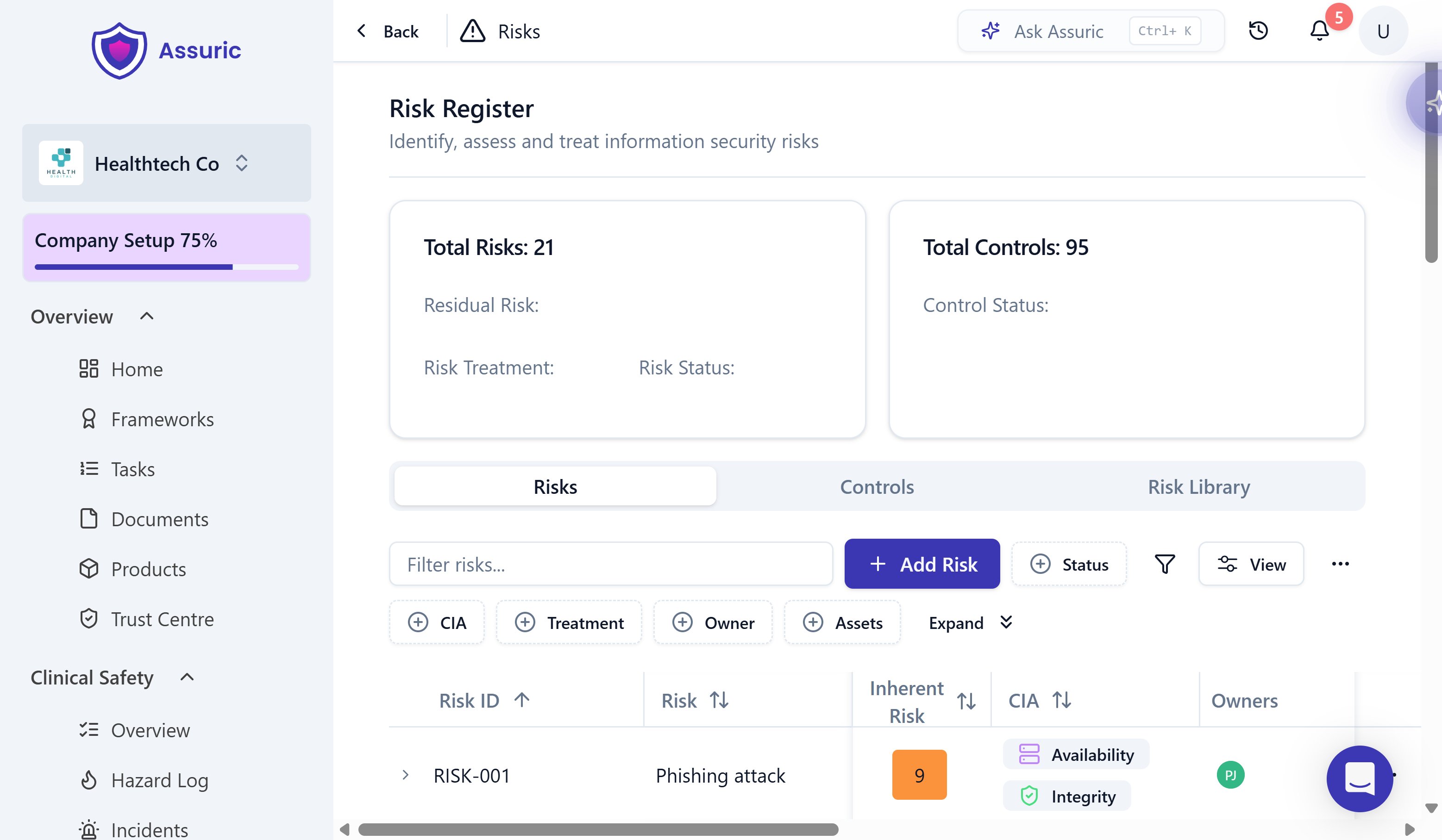
The Risk Register showing the Risks, Controls and Risk Library tabs with summary tiles above the table

The Risk Register, on the Risks tab, showing the Total Risks and Total Controls summary tiles.

Add a risk

1

Open the Risk Register

Click Privacy & Security in the sidebar, then Risk Register.
2

Add from the Risk Library, or create your own

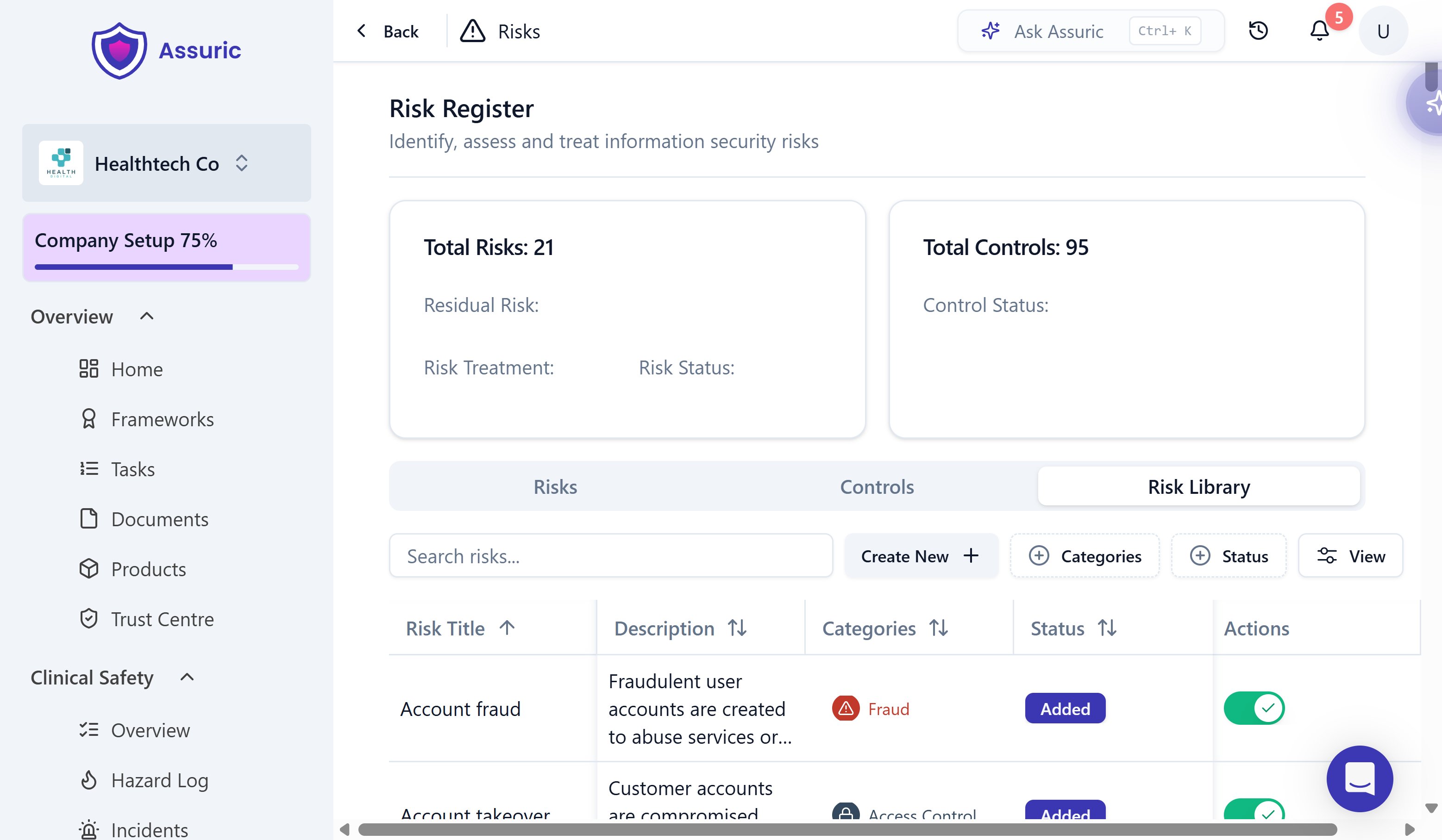
Open the Risk Library tab and add a prebuilt risk, AI-specific ones included, with one click, or Add Risk on the Risks tab to write your own.
The Risk Library tab listing prebuilt risks with their category and status

The Risk Library, listing prebuilt risks with a category and an Add/Added status.

3

Tag CIA and link assets

Set which of Confidentiality, Integrity or Availability (CIA) the risk threatens, and link the Assets it affects.
The Risk Register with the CIA and Assets columns highlighted on a risk row

A risk row with 1 CIA and 2 Assets highlighted.

4

Score it, then treat it

Click the Inherent Risk score to open Edit Risk, then step through Inherent Risk, Controls and Residual Risk, using the levels in How risks are scored. The gap between Inherent Risk and Residual Risk shows what your controls achieve. Choose a Risk Treatment and click Save & Exit.
The Risk Register with the Inherent Risk, Controls, Residual Risk and Treatment columns highlighted on a risk row

A risk row with 1 Inherent Risk, 2 Controls, 3 Residual Risk and 4 Treatment highlighted.

How risks are scored

Likelihood times Impact, each 1 to 5, gives the Overall Rating, from 1 to 25. Inherent Risk and Residual Risk share the scale, and a grey ? badge means the risk isn’t scored yet. Badge colours: green 1 to 4, yellow 5 to 6, orange 8 to 12, light red 15 to 16, red 20 to 25.

Statuses and treatments

Statuses:
  • Open - Draft
  • Open - Pending Review
  • Done - Treated
  • Done - Closed
Treatments:
  • Mitigate
  • Transfer
  • Avoid
  • Accept

Controls and evidence

  • The Controls tab shows each control’s Status (Met, Partially Met or Not Met), linked Risks and Tasks, and owner. Framework controls, such as ISO 27001 Annex A, sit alongside your own, and New Control adds one.
  • Security Controls tasks track the work behind a control.
  • Evidence for any control, incident or other requirement lives in Documents’ Evidence & Files library.

Incidents

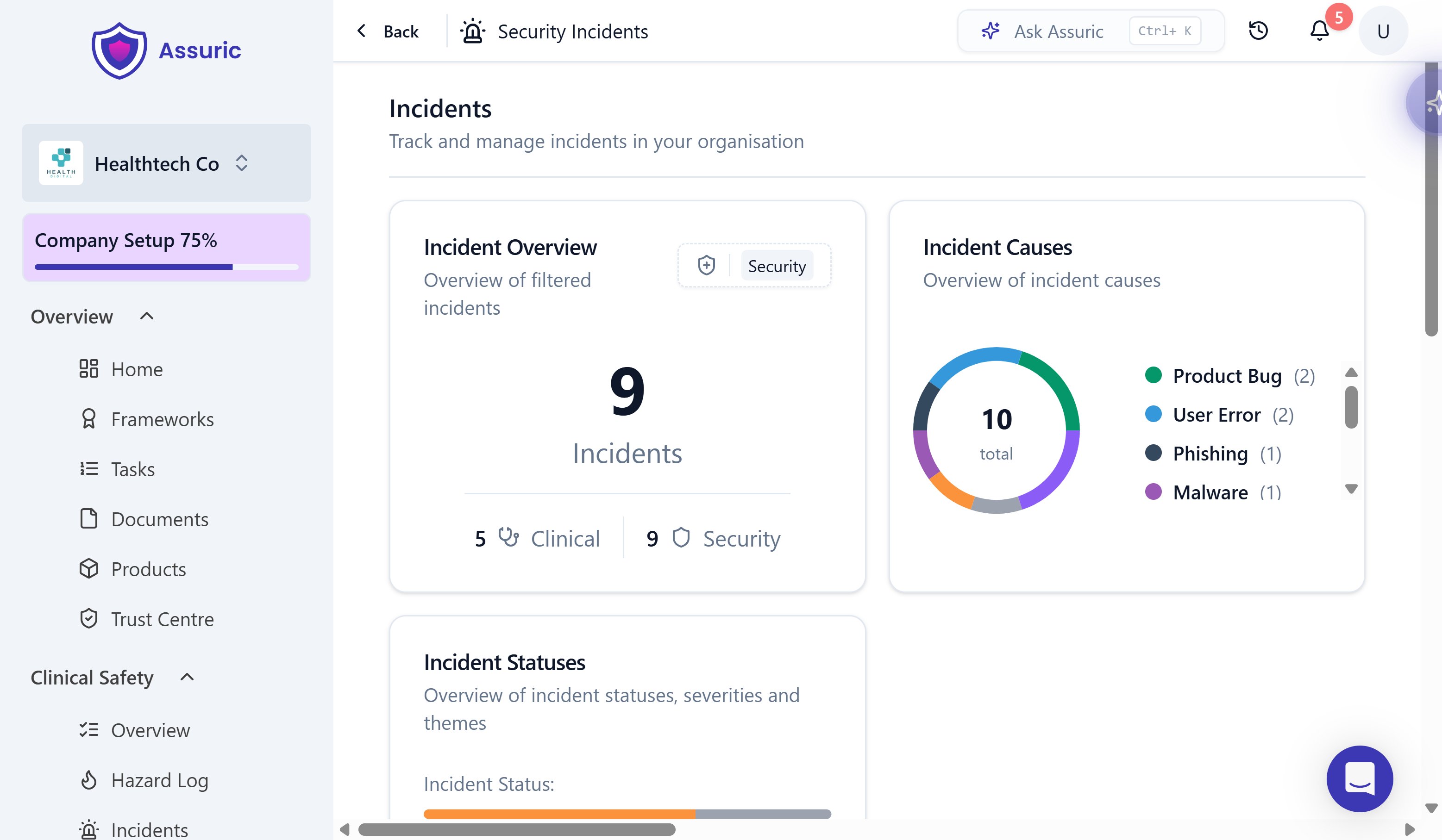
Security incidents link to the risks they realised, through Mapped Risks. Start with the Incidents overview.
The Incidents dashboard filtered to Security, showing the Incident Overview count and Incident Causes breakdown

The Incidents dashboard, filtered to Security, showing the Incident Overview and Incident Causes tiles.

Create a hazard

The same initial-to-residual scoring, applied to clinical hazards.

Create an incident

The shared creation flow behind every incident, clinical or security.

Evidence and files

The evidence library behind every control and incident.

Task categories and statuses

Where Security Controls tasks fit among the other six categories.